
Right now, boardrooms across the country are echoing with this question: “What’s our AI strategy?”
It’s the wrong question.
In regulated markets like banking and insurance, the real question isn’t what your AI strategy is. It’s whether your data is trustworthy enough to support one.
Because without a foundation of clean, consistent, and governed data, AI is just a science experiment. Or worse, it’s a liability waiting to materialize.
The AI Hype Cycle and the Data Reality Gap
We’re in the middle of an AI gold rush. Every vendor is pitching AI capabilities. Every conference is centered on AI transformation. Every board wants to see an AI roadmap. The pressure to “do something with AI” is immense.
But here’s what the hype cycle doesn’t tell you: AI is only as good as the data you feed it. And in most enterprise environments, especially in heavily regulated industries, that data is a mess.
I’ve seen countless enterprise AI initiatives falter. Not because the models were bad. Not because the tools didn’t work. Not because the data scientists lacked skill. But because no one trusted the data feeding the models. Data was scattered across dozens of systems, some dating back decades. Definitions varied by department, with “customer” meaning something different to marketing than it did to underwriting. When AI-generated results didn’t align with expectations or intuition, nobody could say why. Without trust in the inputs, there could be no confidence in the outputs.
The result? Expensive AI projects that sit on the shelf. Pilot programs that never scale. Innovation theater that impresses in demos but crumbles under production pressures.
Why Data Trust Is So Hard to Achieve
The data trust problem in banking and insurance runs deeper than most leaders realize. These industries accumulated decades of technical debt. Core systems were built when data storage was expensive, so information was optimized for space rather than usability. Mergers and acquisitions created overlapping systems with conflicting data models. Regulatory requirements drove point solutions that created new silos rather than integrating with existing ones.
Layer on top of that the pace of change. New products launch. New channels open. Customer behaviors evolve. Each change introduces new data sources, new formats, and new integration points. Without rigorous governance, the data landscape becomes increasingly fragmented.
Then there’s the organizational challenge. Data often has no clear owner. IT manages the infrastructure but doesn’t understand the business context. Business units understand the meaning but lack technical control. Analytics teams want access, but inherit quality problems they can’t fix. Everyone points fingers, and nothing improves.
This is the environment where AI is supposed to thrive. Except it can’t. Not yet.
So Let’s Reset the Conversation
Real AI readiness starts long before you select a machine learning platform or hire data scientists. It begins with 3 foundational elements:
Data Quality and Consistency. You cannot automate what you cannot trust. Before you build predictive models or deploy intelligent automation, you have to ensure your data is complete, timely, and accurate across the enterprise. This often requires a full audit of source systems, data pipelines, transformation logic, and governance frameworks.
What does this look like in practice? It means establishing data quality metrics and continuously monitoring them. It means implementing validation rules at the point of entry, not just downstream. It means reconciling discrepancies between systems in real time rather than through monthly batch processes. It means documenting data lineage so you can trace every data point back to its origin and understand every transformation it underwent along the way.
I’ve worked with organizations that spent 6 months mapping their data landscape before writing a single line of AI code. That time was not wasted. It was invested. Because once they understood their data reality, they could build AI solutions on a solid foundation rather than quicksand.
Data Governance that Evolves with Risk. Many governance models are static, built around compliance requirements and left unchanged for years. AI introduces new risks that traditional governance frameworks never contemplated: algorithmic bias, model drift, explainability requirements, and ethical considerations around automated decision-making.
Modern data governance must be dynamic. You need policies and controls that evolve as your AI maturity advances. This includes establishing clear ownership for AI-generated decisions and creating review processes for model outputs before they impact customers or operations. Building feedback loops that detect when models start degrading. Implementing audit trails that satisfy regulators who want to understand how automated decisions are made.
In regulated industries, this isn’t optional. When an AI model denies a loan application or flags a claim as fraudulent, someone needs to be able to explain why. That explanation requires not just model transparency but complete data provenance. Without governance structures that support this level of accountability, AI becomes a regulatory risk rather than a competitive advantage.
Cross-Functional Understanding. AI can’t be owned solely by IT, nor can it be entirely delegated to a data science team operating in isolation. Business stakeholders must understand what’s driving model behavior and the implications for their operations, customers, and risk profile.
That means clear definitions that everyone uses consistently. It means shared metrics that align technology investments with business outcomes. It means aligned incentives so that improving data quality isn’t just IT’s problem but everyone’s responsibility.
The most successful AI implementations I’ve seen involved business leaders who took the time to understand the basics of how models work and data scientists who took the time to understand the business context. This mutual understanding enabled better prioritization, faster troubleshooting, and stronger buy-in when results challenged conventional wisdom.
Real-World Impact: Measuring What Matters
At Hylaine, we’ve seen firsthand how focusing on data trust first unlocks true AI momentum. A Fortune 100 insurer, for instance, was eager to deploy predictive models for claims processing. Our initial assessment revealed significant data quality issues in their claims history. Dates were inconsistent. Categories were misapplied. Key fields were frequently missing.
Rather than rushing forward with AI, we spent 3 months improving data observability and implementing quality controls. The result? The organization avoided over $1M in potential risk exposure by catching data issues that would have caused the AI model to make flawed predictions. When they did deploy AI 6 months later, it performed better than expected because the foundation was solid.
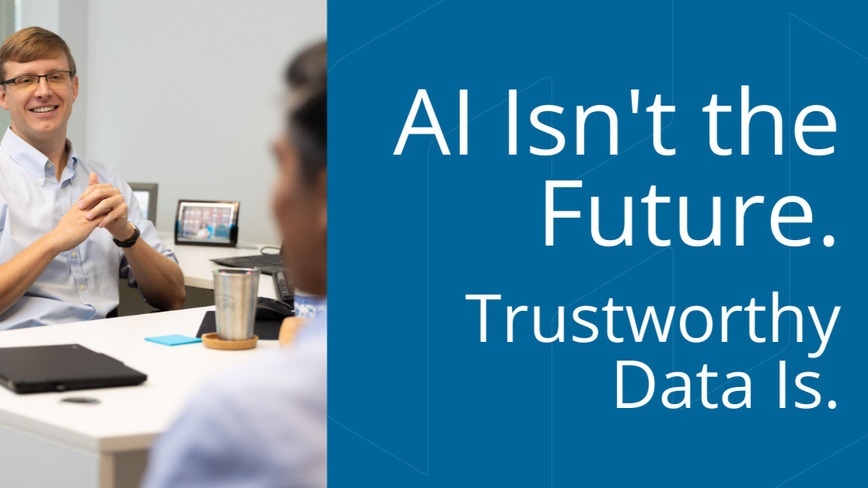
The lesson? Don’t start with AI. Start with trust. Because the future isn’t artificial intelligence. It’s real intelligence rooted in data you can rely on, decisions you can explain, and outcomes you can defend.
The Hard Conversation Every Leader Needs to Have
If you’re a technology leader in insurance or banking and your executives are pushing for AI, you have a responsibility to tell them the truth. Not to say no, but to say “not yet” if the foundation isn’t ready. To redirect enthusiasm toward the less glamorous but more critical work of data modernization and governance.
This isn’t a popular message. It doesn’t generate headlines or excitement. But it’s the right message. Because building AI on insufficient data doesn’t just waste money. It creates operational risk, regulatory exposure, and customer trust issues that take years to repair.
The organizations that will win with AI aren’t the ones that move fastest. They’re the ones that build the strongest data foundation first. That’s not holding back innovation. That’s ensuring innovation actually works when it matters most.